
Cervical posture
Maybe it’s me, but this summer seems to be the busiest ever. For better or worse, we are increasingly dependent on our smart phones and mobile devices.
One unfortunate side effect that stands out, and may not be obviously related, is the poor neck posture. I and many others in the healthcare profession have noticed a trend in neck problems and pain in the wrists and hands. What’s more concerning is the chronic effects.
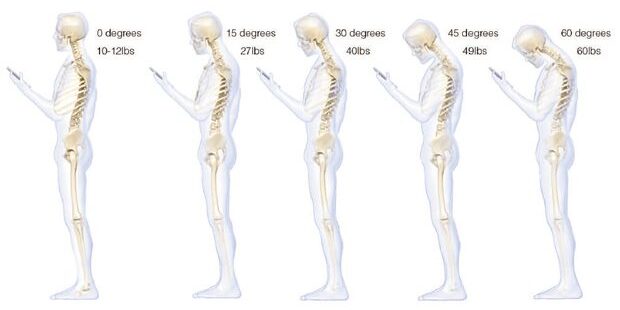
When desktop computers were the extent of our technology, our heads were at a slight angle. Then, laptops arrived and we started looking down at a sharper angle with a rounded upper body. The most insidious contribution has been the smart phone. Instead of raising the phone to face level we crane our necks downward overstraining the posterior neck and back muscles. Let’s not leave out the over-tightening of front neck muscles. Muscular discomfort is the most obvious symptom, but there can be hidden effects from compressing all of the anatomical structures in the front of the neck; i.e. trachea, thyroid, esophagus, blood vessels, nerves. The spine can take a lot of abuse until it reaches maximum compensatory tension. That’s when a vertebra goes out of alignment or a vertebral disc herniation occurs, either of which can impinge a nerve. And all of which are more challenging conditions, typically more painful, to treat.
Dr. Alf Breig, neurosurgeon and Nobel Prize recipient discovered that a loss of the cervical curve can stretch the spinal cord 5-7cm and produce pathological tension putting the body in a state of disease.
How can we practice proper neck posture? A couple ways:
- Think of the axis of rotation as being ear to ear, thus swiveling the cranium at the top of the neck so as to gently tilt the chin down and the back of the head up, thereby lengthening the back of the neck. This keeps the neck balanced over the torso.
- Another way is looking down just with the eyes, holding the mobile device up higher, and maintaining the head and neck in alignment.
The slippery slope is when the axis point is in the lower neck (reference above illustration) and the weight of the head hangs on the small neck muscles. The weight of the head increases with the forward angle of the cervical spine.
One thing we can count on, mobile technology is here to stay. We can only try to remain as aware and mindful as possible, and not let postural challenges get the better of us.